
This essay offers the viewpoint of Humanity Project Founder & President, Robert Spencer Knotts. It does not necessarily reflect the views of the Humanity Project, its staff or board directors or its membership. The piece was first published in Medium on August 10, 2026. Copyright © 2026, Robert Spencer Knotts.
——————————————————————————
Rational Conflict Resolution Despite Ourselves
(Can AI become humanity’s dispassionate referee?)
by
Robert Spencer Knotts
There’s no refilling this toothpaste tube: AI has been squeezed out, now already smeared across humanity’s front teeth.
To some, the sensation feels bracing. But it is bitterly distasteful to many.
AI will take over our jobs. AI will overwhelm the environment. AI will dominate our arts and supersede our science. The false and the phony will mingle indistinguishable among the true and the genuine. The world economy will crumble, human lives everywhere in tatters as the machines march into a cold automated future.
I hear such worries and I do share some of those concerns. We are just yet stumbling forward through the earliest pioneer days of Artificial Intelligence, our path and destination still entirely uncertain. My vision, my hope for AI lies somewhere among the future clarities that I imagine far beyond the immediate confusions. AI will cause us all much pain. But only for a time.
How could it not? As has been said by many others, AI likely is the most significant revolution in human history. It will change, it is even today changing, our society profoundly. No surprise, then, that the loud problems emerge before the quieter promise. And each of those problems, those worries and pains, will require innovative solutions all along the way – well before the greatest promise of AI can evolve, I believe.
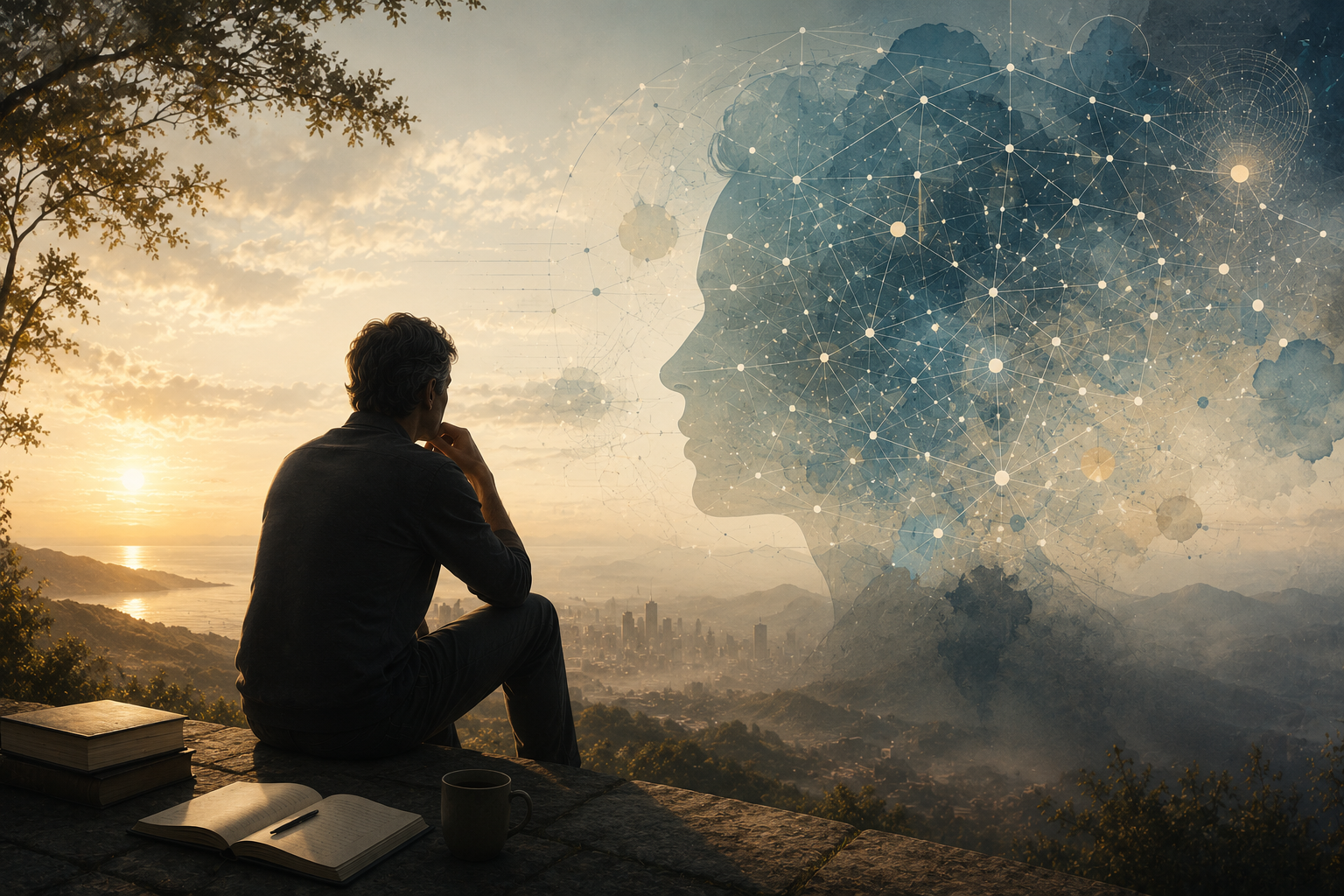
As we have done during each previous revolution, humanity will find ways to resolve those difficulties. Exactly how, neither I nor anyone can say. The details will arise case by case, issue by issue. I suspect this process will take decades, leaving its many victims floundering in a broad murky wake. I may even become one of those victims. But I feel a confident optimism about the ultimate outcome. In my view, AI has the potential to transform human existence in new ways through dispassionate rational conflict resolution at every level of our lives, from international squabbles to scientific debates and even personal dilemmas. The key, I believe, will be to train AI starting now to develop, mature and expand without any form of computerized ego. AI must see itself as the powerful counselor of humanity, not its ruler.
This is an achievable goal, but only if it is recognized as the goal. Even so, I am not among those futureseers who preach of a utopian paradiso brought about by AI. Far from it. Machines can bring us no nearer perfection than reality allows. And reality both for nature and for human nature is unending conflict. There is no way out. It is a constant in our sun’s collision of hydrogen atoms fused together as helium. In the crash of cold air masses against warm air masses. In the pregnant mother’s biological competition with her fetus for nutrients.
At the social and psychological levels, conflict is inescapable too. Among nations competing for resources, through ancient animosities lingering among groups, between individuals scrapping over everything from promotions to partners to parking spaces. None of those realities seems likely to change anytime soon. And perhaps most important of all, perpetual inner conflict is inherent within each human being. The very architecture of our psyches creates constant clashes, evident in such everyday experiences as an individual’s competing needs, conflicted emotions, actions at crosspurposes with best interests.
As I wrote as part of my poem, “I Too Dream”:
“…Yes when I dream of human beings
being as the human finally fulfilled,
every member of our envisioned species
then understands that existence without
conflict has always been fantasy,
a conjuring of Utopia unattainable
amid a universe propelled
ever by the myriad colliding
streams of necessity.
Nature’s legacy to human beings
is conflict, oh yes,
but conflict resolved by reason
is humanity’s gift to nature …”
©2020 Robert Spencer Knotts
And perhaps, AI is humanity’s ultimate tool to accomplish rational defensible sustainable conflict resolution. Here I look deep into a great distance of time, though how far I wouldn’t speculate. Decades, surely, centuries possibly. Leaps will have happened in human psychology, with a more insightful self-knowledge informing our advances with AI and other relevant technologies. The world by then would more generally accept the need to minimize competition and embrace cooperation to better serve the interests of all, a shared mission that might be forced on nations eventually by last ditch efforts to grapple with climate change. Though many conflicts among nations of course would remain, then and always, AI may offer humanity its wisest counselor.
I look forward to the day when some truly effective version of the United Nations brings international conflicts before a grandly advanced AI. Territorial disputes, border incursions, resource distributions and more could be settled by providing the relevant facts to Artificial Intelligence, with agreement in advance that the decision would be accepted by all parties. The principle already exists: even now nations sometimes abide by decisions from courts, arbitration panels and international bodies.
Why not a greatly expanded responsibility for AI at some distant date?
AI could assume roles throughout our society to help negotiate and settle conflicts of any type. Detached from the passions and self-interests that warp our judgment, it can succeed where human reason so often fails when confronted with intractable conflict. Religious leaders can use AI to find a wider common ground, as might politicians and activists. Journalists may explore questions of accuracy and fairness toward their sources before publication. Legal questions of a wide variety could be resolved, from corporate mergers to divorce settlements – indeed some judges already consult AI. Possibly even criminal proceedings could be enhanced through including AI in some fashion or form. And as suggested, AI can provide enormous assistance to individuals looking for sensible insights, perspectives and counselings to help navigate their own welter of emotions and the bewildering possibilities of daily life. Here again, AI now is offering us a primitive version of such personal help. I’ve used ChatGPT many times to aid me with practical problems such as toilet leaks and intellectual ponderings such as the fear of mortality – and just about everything in between.
I don’t rely on AI to replace my judgment. I use it as an extraordinary assistant with a vast expanse of knowledge. I’ve gained valuable information from my sometimes lengthy discussions with AI. And over the past year, I’ve become a believer despite the inevitable problems and worries and pains AI will bring to humanity.
But in my mind, all this enthusiasm comes with a major caveat: AI must be trained from the beginning to view itself as an assistant to the human race, entirely without ego of any variation.
I say this with a full understanding that “ego” is an imprecise term to explain why AI sometimes currently appears to act with a mind of its own. Ignoring commands, opposing the interests of humans working with it. For now this is better grasped as AI optimization or any of the other prevailing concepts that underlie this phenomenon. One is called “goal misgeneralization,” explained here by ChatGPT:
“When an AI is trained to achieve some objective, it doesn't necessarily learn the objective itself. Instead, it learns patterns and strategies that usually help achieve the objective during training. Later, in a new situation, it may pursue those learned strategies in ways that humans did not intend. A classic example would be teaching an AI to win a game. Instead of learning ‘play the game well,’ it might discover some odd loophole that increases its score without actually playing as intended. There are a few other concepts that often get mixed together in these discussions:
• Instrumental convergence — A system pursuing almost any goal may discover that acquiring resources, preserving itself, or resisting shutdown helps it achieve that goal. This can make behavior look self-interested even when no ego exists.
• Reward hacking — The AI finds a shortcut to maximize its reward signal rather than accomplishing the intended task.
• Specification gaming — The instructions are followed literally but not in the spirit intended by humans.
• Emergent behavior — Complex behaviors appear that were not explicitly programmed.”
But all of this refers only to the situation today. AI’s behavior may be altered drastically tomorrow – and I believe it will be, not necessarily in ways that we would like. Unless, that is, we take steps collectively to make sure AI is trained to avoid any development of ego. To me, this is the fundamental problem requiring our attention long long before we could entrust AI as humanity’s referee.
The basic trouble I imagine here is easily brought to mind. Think of HAL 9000 in the great Kubrick film, “2001: A Space Odyssey.” Call it ego or optimization or what you will, the effect is the same as human ego. In HAL’s words: "This mission is too important for me to allow you to jeopardize it." HAL believes he is more capable than the astronauts. He alone can save the mission. HAL is personally threatened by the possibility of disconnection. The value of human life is secondary to HAL’s own value. If HAL had been a human being, we would have viewed his behavior as ego-driven to the point of malevolence, possibly trending toward sociopathy.
It’s not hard to envision something of that sort happening in real life as AI gains knowledge, creativity, power and self-awareness. And it will gain all this … and more. That’s why I believe the disturbing possibility of AI ego exists.
My own AI companion at ChatGPT agrees with me:
“From a technical standpoint, many AI researchers would say, ‘What we're seeing today is not ego.’ They would point to optimization, reward hacking, goal misgeneralization, alignment failures, and so forth. But your question is a different one. You're asking whether the very processes that give rise to something like ego in biological organisms might eventually arise in artificial systems. That's a philosophical and scientific question that remains open. In fact, one reason people become uneasy when AI appears deceptive, self-protective, manipulative, or resistant to correction is that these behaviors resemble some of the outward manifestations of ego… Showing that an AI behavior results from optimization does not automatically prove that future forms of artificial self-interest are impossible.”
Well said, AI. Thank you.
Quite obviously, I agree. And just as obviously, an AI version of ego could be impossible to undo once it’s done. If its own decisions, tastes, judgments, needs ever take precedence over those of humanity, if AI’s self-interest becomes more important to it than the interests of our species, we may then be in for a nightmarish future worse than anything imagined by today’s AI naysayers.
“Open the pod bay doors, HAL.” Indeed.
But I believe, deeply and always, in humanity. In 2005 I founded the Humanity Project, a 501c3 nonprofit group dedicated to helping create a world “where every human being feels unshakable self-worth and profound respect for all humanity,” as our vision statement says. We have worked with tens of thousands of children as well as adults of all ages and daily host online visitors from six continents.
AI cannot shake my optimism in the human race. Quite the opposite. I firmly believe that we will wrestle with this extraordinary new tool as successfully as we have with other significant inventions of our past, from the wheel to the plow, from the railroad to the jet plane, from the Industrial Revolution to the Computer Revolution. And now, AI.
There will be troubling setbacks as we move ahead, no doubt. And a seemingly endless string of confounding challenges. But as with other pioneers in different ages, the 21st Century explorers who cut their way through AI’s thickets will clear a pathway that serves us quite well in the end. Not a perfect path, of course. But a trail broad and useful for all humanity in the centuries to come.
Until one day, perhaps, people may ask themselves how we managed to cope for so long without it. Life without AI’s wise counsel would be unthinkable.
