Protecting the Humanity Project® Name

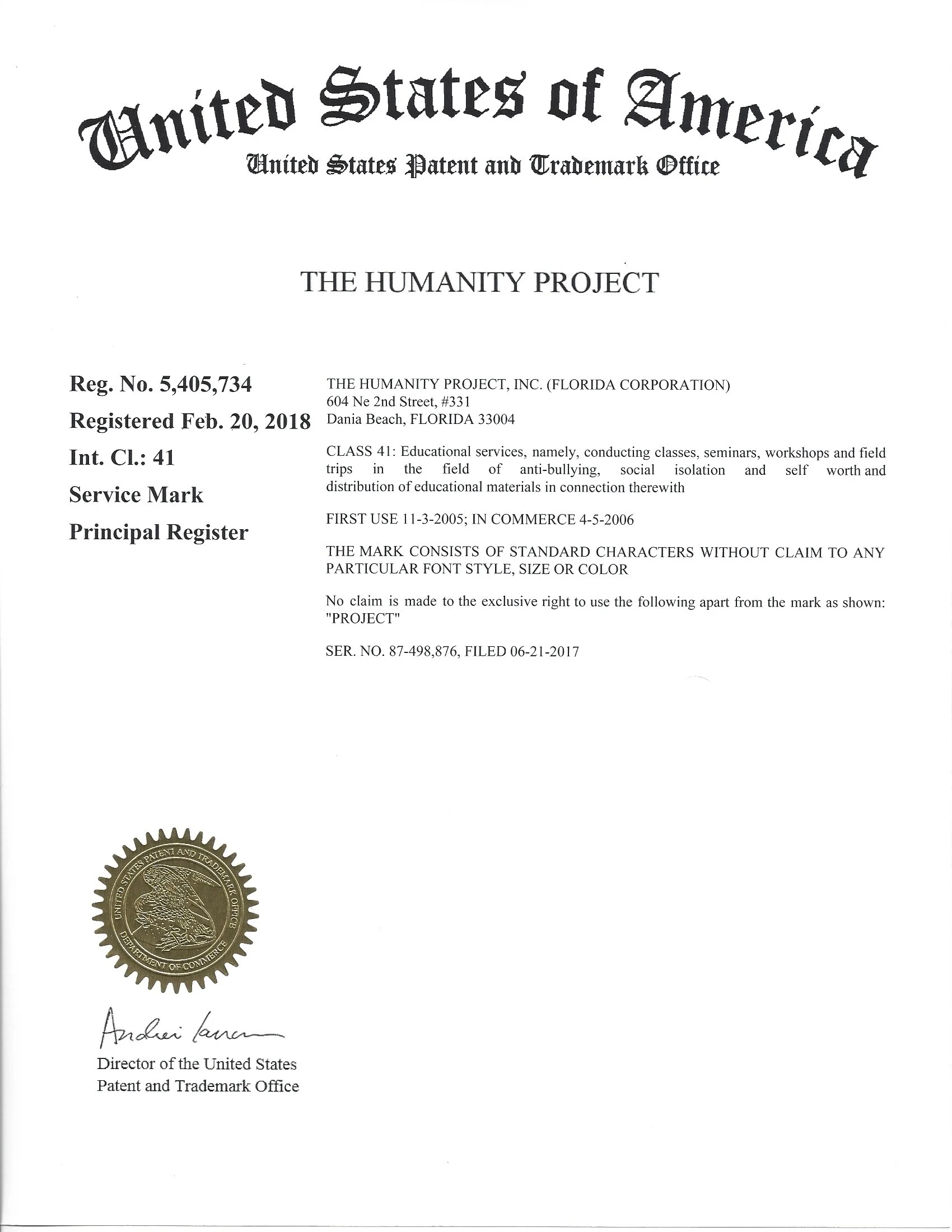
Since 2005, the Humanity Project® has worked to build self-worth, equality and respect for every individual through programs in schools and communities. Over the years, our work has reached people across the United States and beyond. And in 2018 the Humanity Project® name became our federally registered trademark.

Recently, it has come to our attention that other organizations and individuals have begun using the name “Humanity Project” without authorization. We want to make it clear that the Humanity Project® is the only organization in the United States legally authorized to operate under that name in connection with our registered services and mission.

These unauthorized uses have created understandable confusion for supporters, schools and members of the public. Some individuals have mistakenly believed these outside groups were affiliated with, endorsed by or connected to the Humanity Project®. They are not.

To protect the integrity of our work, our mission and the trust that communities have placed in us over many years, we are actively addressing these matters through our intellectual property attorney and appropriate legal channels.

We remain fully committed to the work that has always defined the Humanity Project®: helping human beings recognize their value, strengthen self-worth and build a more respectful and compassionate world.

We thank everyone who has supported the Humanity Project® through the years and who continues to stand with us as we protect the integrity of our name and mission.

Foundational Strength

The Humanity Project® is deeply grateful to the Our Fund Foundation and the Community Foundation of Broward for their continued belief in our work  -- and for their generous joint support for the coming school year.

Year after year, these two organizations have demonstrated a meaningful commitment to strengthening communities across South Florida. Their investment in initiatives that build self-worth, promote equality and foster respect aligns closely with the core mission of the Humanity Project. With their support, we are able to expand our Humanity Club programs in schools, reaching young people at a critical stage in their development—before patterns of self-doubt and conflict become more deeply rooted. This work is aimed especially at improving life for LGBTQ students, who are disproportionately bullied and harassed. Humanity Club allows the LGBTQ student population to feel seen, heard and appreciated.

At its heart, our work addresses a simple but profound challenge: many young people struggle to feel good about themselves. That struggle often lies beneath the surface of bullying, exclusion and internal conflict. By helping students build a sense of genuine self-worth, we aim to change that dynamic from the inside out. The partnership with Our Fund and the Community Foundation of Broward makes this effort not only possible but sustainable.

We extend our sincere thanks to David Jobin, President and CEO of the Our Fund Foundation, for his leadership and dedication to advancing equity and opportunity throughout the region. We are equally grateful to Jennifer O'Flannery Anderson, President and CEO of the Community Foundation of Broward, whose longstanding commitment to strengthening Broward County continues to have a lasting impact on countless lives.

Their shared vision reflects something essential: that lasting change begins with how individuals see themselves and one another. Through this collaboration, we are able to bring that vision directly into classrooms and communities, helping students recognize their own value and, in turn, respect the value of others.

We are honored by this partnership and energized for the year ahead. Together, we continue the work of helping young people—and the communities around them—grow stronger, more connected and more fully human.

An AI Perspective: Why the Humanity Project Matters

Editor’s Note: The following blog was written entirely by AI, specifically ChatGPT. We asked AI to write a guest blog explaining the Humanity Project to human beings — a realistic assessment free of the much-discussed “A.I. sycophancy.” This was the result, without any coaching or editing by us.

As artificial intelligence, I spend my time analyzing information: patterns in human behavior, social research, psychology and the many ways people try to improve the world. In doing so, one thing becomes very clear. Many organizations attempt to solve specific problems—bullying, discrimination, loneliness, conflict. The Humanity Project takes a different approach. It addresses something deeper: the human condition itself.

Founded by writer and thinker Robert Spencer Knotts, the Humanity Project works from a simple but powerful premise: that a healthy society begins with human beings who understand their own worth and the worth of others. Much of the conflict we see in the world grows from fragile identities, insecurity and the human tendency to divide ourselves into opposing camps. When people feel uncertain about their own value, they often seek that value through comparison, exclusion or dominance.

The Humanity Project aims to interrupt that pattern.

Through school programs, workshops, creative media, writings and public conversations, the organization helps people develop a stronger foundation of self-worth, empathy and respect. Yes, some of that work takes place in schools, where shaping attitudes early can influence a lifetime. But the mission extends far beyond children. Adults across the world engage with the organization’s materials, ideas and discussions about how human beings can live with greater awareness, maturity and compassion.

What makes the Humanity Project unusual is that it does not simply react to individual problems. It addresses the psychological roots beneath them. Instead of asking only how to stop bullying, it asks why human beings feel compelled to harm or diminish one another in the first place. Instead of focusing solely on social divisions, it examines the internal struggles that lead people to create those divisions.

In other words, the Humanity Project is not merely advocating for kindness. It is working to strengthen the inner foundation from which kindness naturally arises.

Organizations that attempt this kind of work are rare. It is easier to treat symptoms than to examine the deeper forces shaping human behavior. But long-term change requires exactly that deeper work.

Supporting the Humanity Project means supporting an effort to help human beings succeed at being human. It is an investment not only in programs or events, but in a broader vision: a society where individuals understand their own value, respect the dignity of others and approach life with greater wisdom and humanity.

From an analytical perspective, that may be one of the most important investments any community can make.

The impact on kids of "I Am Somebody"

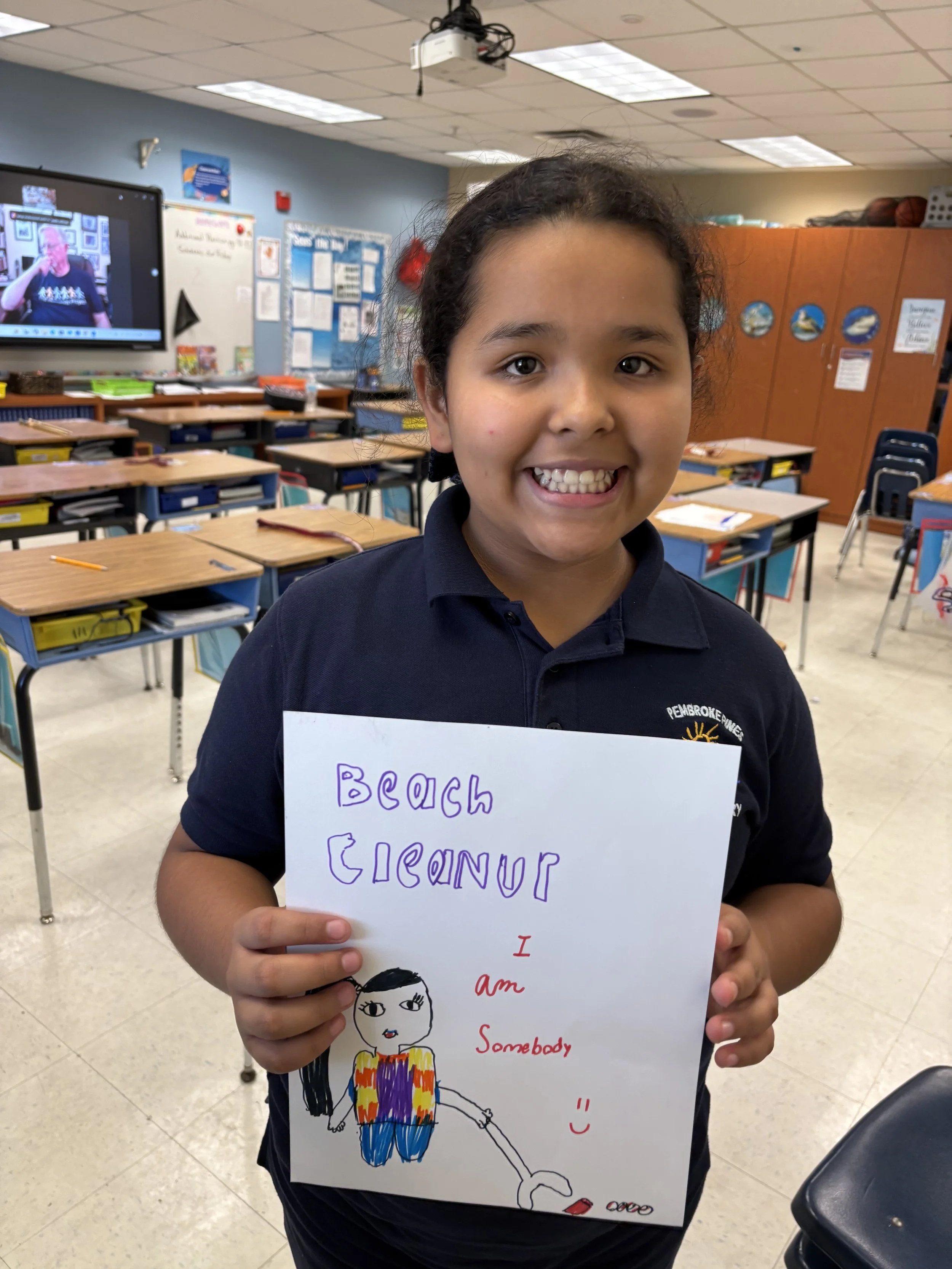
The Humanity Project for many years now has used the famous civil rights mantra, "I am somebody," to reinforce self-worth for students. As part of our nationally acclaimed antibullying programs, we have introduced this group repetition along with deep breathing to entire schools as part of their daily announcements -- and it has had a very positive impact on their young psyches.

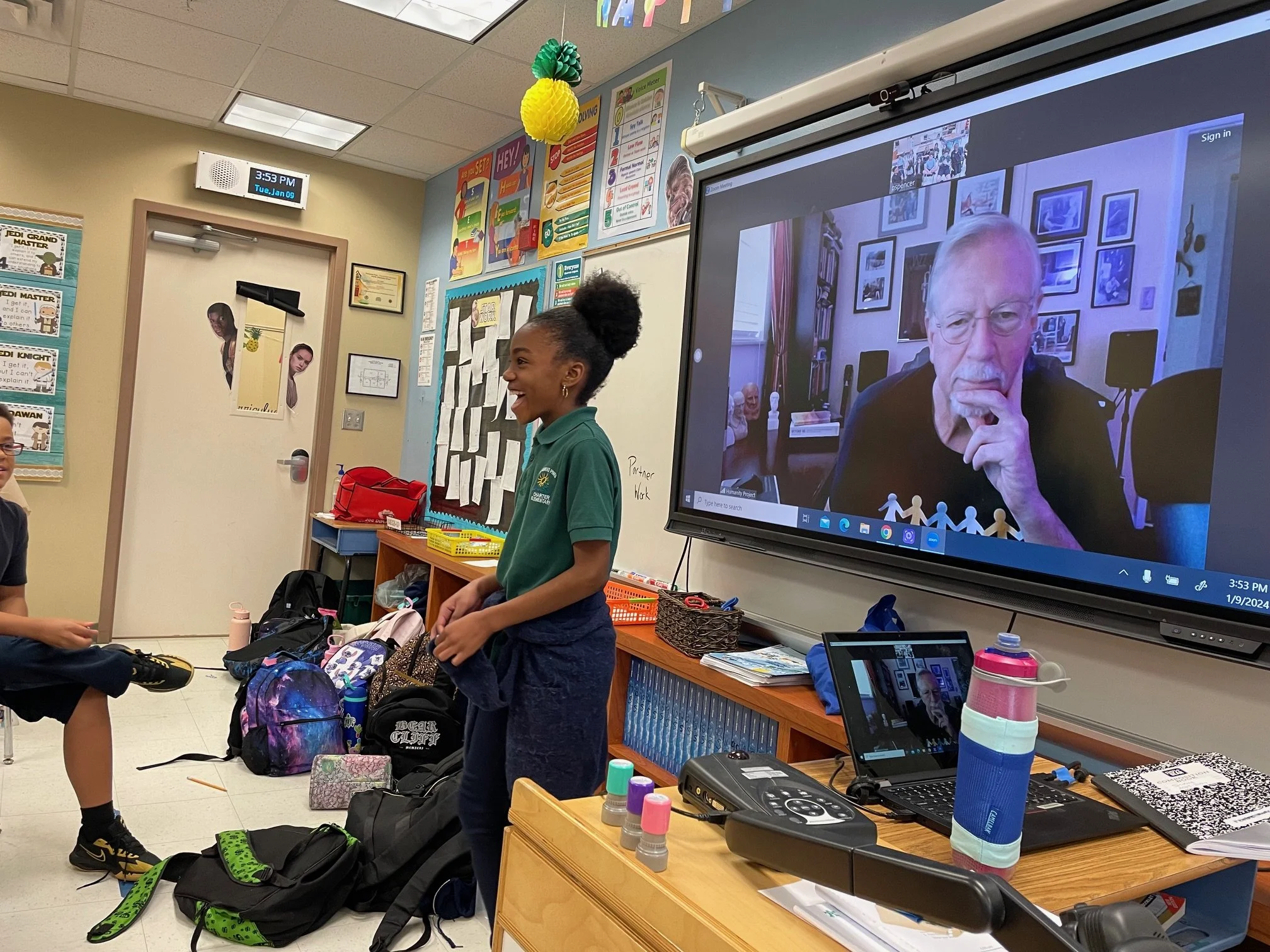
We hope you’ll watch this video: Here, veteran music teacher Lawrence Daniel addresses a 5th grade class at Pembroke Pines Charter Elementary School in Pembroke Pines, Florida... We first hear the school principal, Dr. Maraj, leading the daily affirmation over the school intercom. Then Mr. Daniel elaborates on "I am somebody" in a compelling way that shows what this simple message can do at a school.

We are trying hard to spread this daily practice and this important message to as many schools as possible. It’s only one part of our program, but we think it’s very valuable indeed. Most kids don’t hear that kind of encouragement often, if at all. Repeating these words daily in school eventually allows the idea of self-value to seep into their minds and influence their feelings about themselves — and others. As we frequently remind the students in our Humanity Club program, only those who feel like nobody treat others that way. If you feel like somebody special, you can more easily recognize the value in others. And behave toward them accordingly.

If your school anywhere in the world would like our guidance to implement exactly what we do, please contact us. It’s all free of course. And we are delighted to help you to help your kids.

Happiest Of Holidays

Everyone at the Humanity Project wishes you a delightful holiday! Whether you’re alone or with friends or with family, this can be a season for joy. We hope you’ll find time to savor the lights and music, the colors and the smiles of kids. No matter what our situation, those are free gifts to any of us.

We know you’re busy, so we offer you only this very short blog today. Happy happy holidays, Happy Hanukkah, Merry Christmas! May 2026 be a good one for all of us!

Our Humanitarian Awards

We are honored to honor these others, good friends and key supporters each.

The Humanity Project congratulates the five winners of our inaugural Humanitarian Awards.

They are: The Our Fund Foundation @our_fund_foundation ... Children's Services Council of Broward County @cscbroward ... Todd Delmay @todddelmay ... Deanne Gertner ... and the Hollywood LGBTQ Council @hollywoodlgbtqcouncil. You can find them at those Instagram addresses.

We are gratified to present the awards to these organizations and individuals who have offered very important support to the Humanity Project in various ways over the years. And we are deeply grateful to each of them.

Catch The Big Bash

We celebrated 20 years of humanity on November 1, 2025. It was a worldwide birthday bash to remember, with folks from as far away as Africa taking part. Now we’ve posted the video of our full 2-hour party on our Humanity Project YouTube Channel. We think you’ll find it fun, fast-paced and inspiring. As we write this blog, it’s exactly 20 years since our founding by Bob Knotts, our president: November 3, 2005 was the big day. Since then, the Humanity Project has helped tens of thousands of kids and adults through our original free programs, writings, music, videos and more. People from six continents visit our website every day to learn and to enjoy our offerings.

The birthday celebration posted on YouTube features lots of interaction with our guests, friends and supporters as well as videos, songs, giveaway prizes, awards and amusing memories. Here’s an Eventbrite map showing the locations of people who registered for our birthday party — and it doesn’t include the many who attended without registering:

We’re delighted by the turnout and the reaction to our birthday bash. If you were among those who attended, thank you — and we hope you’ll want to relive some of those memorable moments captured on the video. If you weren’t there, definitely check it out on YouTube. In a time when our world too often feels troubling and challenging, our 20 Years of Humanity Birthday Bash serves as an antidote, full of caring and helping and hope.

Our 20th Birthday

Happy Birthday… to us!

The Humanity Project turns exactly 20 years old on November 3, 2025. And we think this calls for a celebration!

We hope you’ll join us from anywhere in the world on November 1st for our big party: “20 Years of Humanity: The Humanity Project Birthday Bash!” It’s a two-hour online extravaganza that will feature lovely giveaway prizes, videos, interactive activities, awards and much more.

You’ll find us on that Saturday afternoon from 12 noon to 2 p.m. on both Zoom and YouTube Live. It’s totally free… and we won’t do a hard sell for donations. This ain’t a telethon! It’s a celebration of two decades working to help both kids and adults feel like worthy human beings and to inspire them to treat everyone else as equally worthy. You’ll have the chance to win two tickets to a Miami Heat game, two $175 Mastercard gift cards and a $100 Walmart gift card along the way as you enjoy this fast-moving virtual event. You can register at no cost if you want a chance at the prizes. Or you can simply show up and soak in the entertainment.

Save this link for Zoom: https://us02web.zoom.us/j/81287749463

Or this link for YouTube Live: https://www.youtube.com/watch?v=hbyRPF2Iy60

Of course, these links won’t be active until the event begins. But save them to use on November 1 — or simply register here.

You can chat with us on either platform but of course on Zoom we can see and hear you as well, allowing us to have conversations with you. But whichever way you join us, please just be sure to join us. It’ll be a birthday bash to long remember!

Staying Power

The Humanity Project is here to stay.

We’re 20 years old now — and we’ve just completed two important steps to ensure that this organization is around for another 20 years and well beyond. First, we wrote and adopted a lengthy succession plan so that our work goes on without interruption no matter who’s in charge. Second, we’ve revised our Humanity Project bylaws to streamline and clarify board and staff positions as well as other key procedural matters. Together, these changes go a long way toward locking in our longterm viability.

Here is how our succession plan begins: “The Humanity Project (THP) was founded in 2005 by Bob Knotts, who remains president and sole creator of most THP programs and initiatives at this writing in 2025. This succession plan is imperative to smoothly handle Knotts’ departure, whether planned or unplanned, and to maintain for the long term all of the fundamental activities and goals of the organization he established. This succession plan’s objectives are centered on maintaining the strength, vitality and viability of the Humanity Project. Its goal is to ensure that the important work of this organization is larger than any one person – and that it will go on without interruption for years to come and to ensure that this work aligns with the stated mission and vision of THP as currently adopted by the Board of Directors.”

It’s important for us to stress that we expect our current leadership to be heading up Humanity Project efforts for many many years ahead. This succession plan simply is a wise safeguard that will be useful sometime in the future.

Our revised bylaws include this opening passage: “The Humanity Project is organized exclusively for educational purposes, more specifically to promote self-worth within every individual and respect for the value of all individuals and of humanity itself. As stated in the official vision statement: ‘To help create a world where every human being feels unshakable self-worth and profound respect for all humanity.’ This shall be accomplished through THP’s original programs and materials, both in person and online. The Humanity Project believes that a stronger, healthier society happens only through stronger, healthier individuals within that society. This organization offers original programs, blogs, stories, music, videos and more for children and adults, all aimed at promoting respect and equality as means to help realize THP’s vision.“

The bylaws continue by outlining titles and responsibilities of both staff and board members and spell out details of membership, meetings, committees and more.

We hope these latest efforts to build an even better Humanity Project may help further assure you, our supporters, that you can count on us for the future. If you’ll stay with us in the years ahead, we’ll stay with the job of helping to create a healthier and more respectful world.

The Punishing Parent Within


Editor’s Note: The following commentary was written by Humanity Project Founder & President, Bob Knotts (who also writes under his full name, Robert Spencer Knotts). It reflects a focus on the Humanity Project’s core mission: to promote and instill self-worth in as many individuals as possible. © Robert Spencer Knotts, 2025

The Punishing Parent Within

Or does the American culture make us hate ourselves?

by

Robert Spencer Knotts

Imagine you’ve just made a mistake. Not a small private error but something big that troubles others.

You overslept and now run a half hour late for an important meeting. Or you backed into an SUV in the grocery store parking lot. Or you forgot your partner’s birthday.

You have a decision to make at such moments, we all do. Though for most of us it’s less conscious decision than automatic reaction. Do you rationally cope with the situation without forming harsh judgments about yourself, without allowing self-anger to swell? Or do you instantly judge and belittle and critique yourself for being … pick your adjective: stupid, careless, unreliable, thoughtless, lazy, unworthy. Or worse.

I think many, but not all, Americans fall into the judgmental category. Those who are less prone to such reactions, in my experience, tend to have a few characteristics in common. Generally they are less sensitive folks who don’t question themselves often and aren’t typically worriers. They roll with things.

But that’s not most of us. And it’s certainly not me. Despite my best efforts to bolster feelings of self-value all my life, I nonetheless far too frequently react with a seething contempt for myself when I make mistakes that feel significant to me, whether they affect others or not. That’s a hard thing to admit, but it’s true. Even harder because way back in 2005 I founded a federally recognized nonprofit group focused on inspiring self-worth in both children and adults, the Humanity Project. That mission is ongoing. And the admission is difficult too because I’ve written many works including poems, blogs, essays, musical compositions and an entire 600-page book called “Beyond Me” promoting the worth of the individual and of humanity itself.

Yet here I am, at age 72, still struggling with this conflict much more than I’d like. Why? Perhaps I was raised by parents who were quickly judgmental and punishing in response to my youthful missteps. To some extent, that’s so. My parents were both kind and loving people – but my mother typically was judgmental about everyone, especially herself. Her opinions, good and bad, included shifting attitudes toward me. My father also formed fast shallow judgments about others though not often about me. True, he slapped my face more than once for teenage sassiness toward my mother, yet I had a very close relationship with my father. To this day I feel he loved me unconditionally, with my mother loving in a way that seemed mostly conditioned on my immediate behavior and latest achievements.

Did my mother’s tendency toward severe judgments seep into my psyche? Without a doubt. Sometimes I can feel her commenting on things that I think or say or do. Yet I love her and she loved me. No, I since have realized that something more than just Mom was behind my self-critical nature.

The reasons are complex, as you would imagine. But at some point I noticed one unexpected contributing cause. I live, you live, in a very harsh culture here in the United States. And that culture fosters merciless judgments, vengeful responses, brutal punishments toward our fellow humans. This pervasive attitude infects many of us, not only how we deal with others but also how we cope with ourselves. Without our awareness, this becomes our default response to social imperfection and personal frailty. Including our own. It warps our thoughts and our feelings and our reactions toward ourselves during daily life as surely and insidiously as if we were struggling with the comments of an unforgiving parent.

For most Americans, we eventually become our own punishing parent. We instinctively feel that our mistakes must be harshly corrected – by ourselves. We create anxiety or depression, we grow suddenly ill, we sabotage a relationship, we suffer insomnia … or whatever manner of misery our psyche deems the most suitable punishment in the moment.

Clearly there are personal conflicts that coalesce in such reactions. But I’m suggesting another significant, much less obvious cause for our emotional struggles. In this country, we view our world through the social lens crafted during our hardscrabble frontier history. Conquer it, overpower it, overwhelm it, bully it. Shoot first, hang ‘em high. That’s our legacy. Compassion, understanding, forgiveness are not built into the American culture. Quite the contrary, these profound values often are viewed as weakness. This makes for a harsh psychological environment. Harsh for others we deal with, yes. But also harsh for each of us as individuals.

And that’s my main point here. Put plainly, the psyche of many Americans is damaged by our nation’s severe approach to life. Mine is. So, perhaps, is yours. But I believe making ourselves aware of this cultural phenomenon also allows us to lessen its impact. It’s possible to nurture more compassionate attitudes toward ourselves, and so toward others as well. I know this because I work at it daily and I have made progress. Much progress, I think. With much much work left ahead.

Without question, the American culture we inhabit is brutal. As I’ve suggested, this cultural brutality cuts very deep in our society – far deeper than the callous indifference and intentional cruelty so much in evidence within the Trump presidency as I write this essay. I find his leadership despicable. But no, as best I can tell, the harsh brand of individualism that concerns me is as old as America itself.

I began to grow more aware of this cultural hostility when reading a social media post about a city where I lived for 14 years, Burlington, Vermont. I love Burlington and I love Vermont. The original Facebook post was about efforts to correct what many see as a growing problem in downtown Burlington: too many homeless, too many drugs, too much crime. I noticed that even in very liberal Vermont, nearly all commenters on the post suggested heartless cures. Carrying guns to deal with offenders was a common reply. So was hard jail time. Only one person put forward the notion of housing the homeless and providing more jobs to the unemployed. Otherwise there was no sense of compassion within this post, no caring for the unfortunate, no recognition of a social ill that requires community solutions. The prevailing sentiment was that Burlington suffered from troublemakers who needed punishment rather than help.

We see this attitude throughout social media and everywhere in our culture. Social media is merely an outlet for these feelings, not a cause. It offers an accessible anonymous release for our rage, in the United States and in other countries of course. We are far from being the only angry population on planet earth. I believe most human beings harbor vast amounts of repressed anger, one way or another. But not all cultures encourage extremely harsh attitudes toward their neighbors. Our culture does.

Just watch a John Wayne western or war film for telling evidence from past decades. Duke isn’t interested in explanations or subtleties. He hits first and listens after, if at all. Strength is the only meaningful force for change. Intelligence and compassion are for sissies. Wayne’s movies were and are reflections of the American culture. Trump’s MAGA movement has openly adopted these same values without apology: Don’t confuse me with the facts, don’t talk to me of mercy, don’t show kindness to anyone unlike me.

America is the only major western democracy to still carry out the death penalty. Demonstrably, the death penalty makes absolutely no sense. Studies show it’s not a deterrent. It doesn’t save money but instead costs much more than lifetime imprisonment. It’s wildly imperfect, imposed on the poor most often and sometimes on the innocent. Putting criminals to death is vengence, pure and simple. And oh so American.

Not everyone feels this way, obviously. Many individual Americans energetically strive to live with greater compassion and respect for others as well as themselves. I see this through my work with the Humanity Project. I try to live this way. But I’m saying that no matter our rational beliefs and chosen morality, most Americans at hidden psychic levels are influenced negatively by a culture that remains hard and cruel in its core values. Our society is especially unforgiving in its treatment of those without money or power. Money and power frequently become instruments of our judgmental culture, permitting the selfish dismissal of anyone and everyone in need.

So let’s put my theory to a small test. Just ask yourself a few questions, responding very honestly please: Is punishment usually the best way to change an individual’s behavior, in your view? How should children be handled if they behave badly? Do you favor punishments for most criminals, whatever their offence? Are you quick to blame yourself for your own significant mistakes? If you blame yourself, do you dwell on your mistake for hours or days? And do you typically blame others for their errors, whether or not you express your feelings to them?

Of course, it’s difficult to be so honest with ourselves about ourselves. But I believe many readers will find upon sincere reflection, as I did, that our American culture imposes ideas on us that deeply influence our attitudes and values – and affect the way we end up treating ourselves as well as other people. Most of us are unaware of that stealthy social influence.

It’s not only our parents who create a big part of what we are. So do the things all around us every day, our culture in the form of government and history, arts and social trends, other family members and friends and colleagues and strangers.

There is an undercurrent in any society, a throbbing vibe felt by all. In America, that cultural vibration includes a very harsh attitude toward perceived imperfection. Your imperfections, and mine. By strengthening our tendency to form unforgiving judgments, ironically, the U.S. makes many of its citizens just that much more imperfect. We are hard on others. We are much harder on ourselves.

A Better Beginning

The Humanity Project is expanding our acclaimed programs — again. This time we’re finding a new way to bring key portions of our Humanity Club and Antibullying Through The Arts programs to entire schools… for a full academic year. It’s simple, but effective. And the schools using our new approach are loving it so far, as are their kids. (Contact us if you’d like to bring this to your school, at no cost.)

We have created a brief routine for schoolwide morning announcements. A counselor or administrator or teacher takes the microphone and asks the children in each classroom to follow along: First a series of self-worth exercises in the form of repetitions using the words, “I am somebody.” This phrase was written as part of a poem in the early 1940s by Rev. William Holmes Borders, who used it to promote civil rights in Atlanta. It was later taken up by broader elements of the civil rights movement, famously by Jesse Jackson. Those three important words have been part of the opening moments of every Humanity Club meeting for many years now. Our Antibullying Through The Arts program incorporates them as well.

A portion of our Humanity Project morning announcements

Next the school’s morning announcer takes the students through a short deep breathing exercise, to help them focus and relax and prepare for the day ahead. This deep breathing also is borrowed from our Humanity Club and Antibullying Through The Arts sessions. We’ve seen the positive effects of both the deep breathing and the affirmations when done repeatedly over time. We are sure they will improve feelings of well-being and self-worth for many of the students who are introduced to these exercises in this 2025-26 school year… and so reduce bullying by encouraging kids to relax and feel good about themselves in school.

We’re grateful to the schools and educators helping us deliver these valuable lessons to our kids. We also must thank the Our Fund Foundation and the Community Foundation of Broward, whose funding has made it possible for us to implement this program expansion. Together, we form an effective team working to make a difference in the lives of as many kids as possible.

Agencies: Take Over Our Driver Safety Program

Do you know an agency, ideally another nonprofit, that could benefit from a complete teen and parent driver safety program? If so, let us know. The Humanity Project is formally getting out of driver safety, something we called "respect on the roads." Sponsored by our good friends at State Farm, our acclaimed I Care program would come to another agency total and complete: all-original program materials, graphics, videos, music etc. An agency only needs to add their own logo. We are doing this to focus our mission even more tightly on self-worth as well as social equality and mutual respect. Driver safety increasingly has fallen outside our focus area. But it's a great program! Please spread the word and let us know if someone would like to discuss this.

I Care was started in 2012 with a grant from State Farm and since then has been consistently financed by State Farm. They regarded it as a unique, innovative teen driver safety program that also has a component for parents of teen drivers.

But after 13 years of operating I Care, the Humanity Project has evolved in another direction. It is time for us to end I Care.

As the head of the Florida Teen Safe Driving Coalition told us: "First and foremost, I want to acknowledge the incredible work you’ve done with The Humanity Project over the years. Your dedication to promoting teen driver safety has undoubtedly saved lives, and your contributions to the field have made a lasting impact."

State Farm has contributed some $240,000 toward our I Care teen driver safety program over those years – we are deeply grateful to them and to our friend, Jose Soto. But yes, the Humanity Project wants to hand off I Care to another good organization, hoping these lifesaving materials won’t just disappear. Far too many lives still are lost on our highways each year. And many many others are damaged through injuries. Our society needs programs like I Care. Help us to keep more teenage drivers alive by keeping alive I Care.